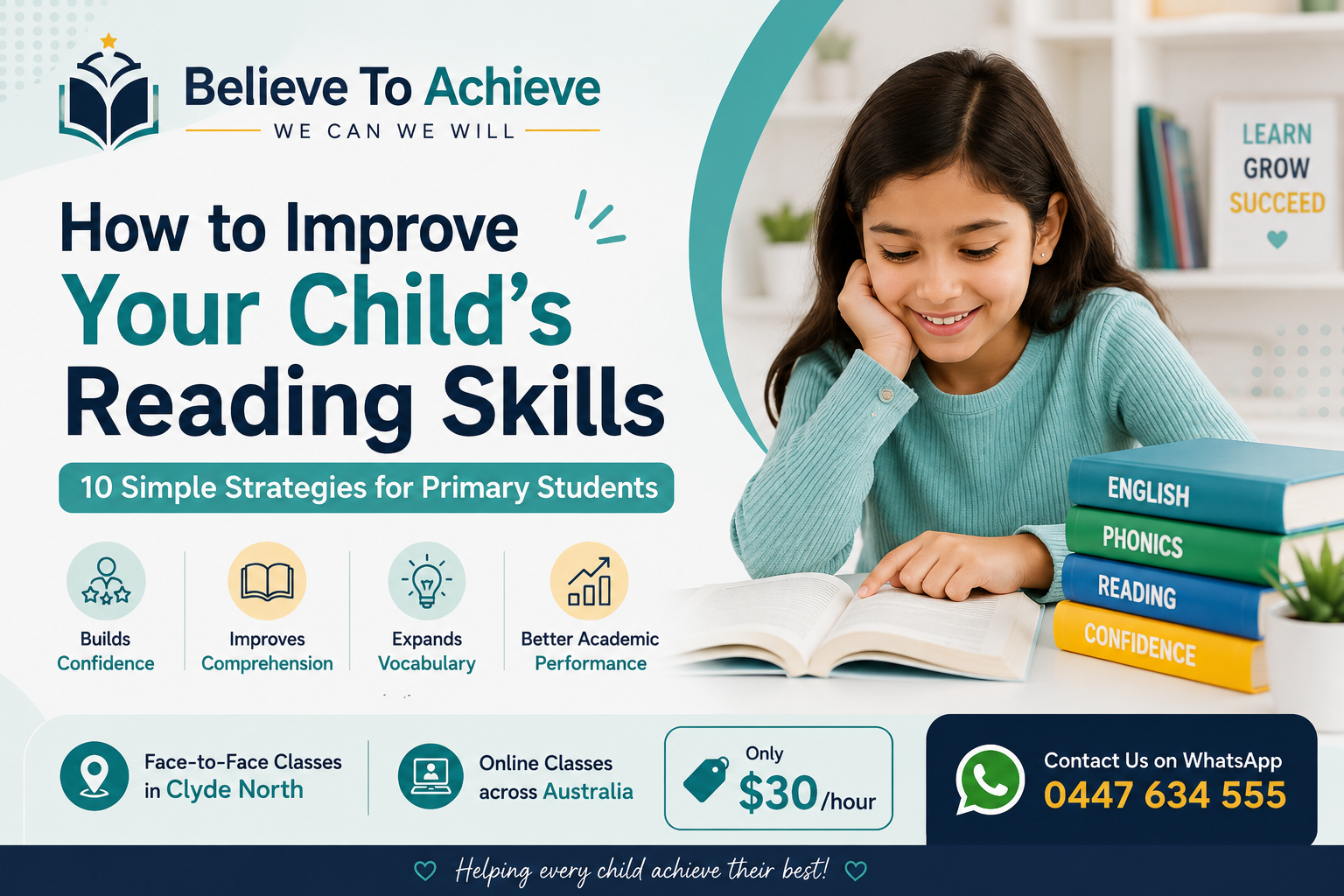
How to Improve Your Child’s Reading Skills: 10 Simple Strategies for Primary Students
Introduction
Reading is one of the most important skills a child develops during their primary school years. Strong reading skills help children understand their schoolwork, communicate confidently and develop better writing and vocabulary.
However, not every child naturally enjoys reading. Some children may struggle with unfamiliar words, reading fluency, spelling or understanding what they have read.
The good news is that reading skills can be developed with regular practice and the right support.
In this guide, we explore 10 simple and practical strategies that parents can use to help primary school children become more confident readers.
Why Are Strong Reading Skills Important?
Reading is much more than simply recognising words on a page.
A strong reader should gradually develop the ability to:
- Read words accurately
- Understand the meaning of a text
- Build a wider vocabulary
- Identify important information
- Make connections between ideas
- Explain what they have read
- Develop reading confidence
These skills support children across subjects such as English, Maths, Science and Humanities.
10 Simple Ways to Improve Reading Skills
1. Make Reading Part of the Daily Routine
One of the easiest ways to improve reading is to make it a regular part of your child’s day.
Even 15–20 minutes of reading can provide valuable practice.
Choose a convenient time when your child is relaxed. This could be after school, before dinner or as part of their bedtime routine.
The goal is to make reading a normal and enjoyable part of everyday life.
2. Let Your Child Choose Books
Children are more likely to enjoy reading when they have some control over what they read.
Allow your child to choose books based on their interests.
They might enjoy:
- Animals
- Space
- Dinosaurs
- Sport
- Adventure stories
- Mysteries
- Funny stories
The important thing is to encourage reading rather than making every reading session feel like homework.
3. Read Together
Parents do not always need to leave children to read independently.
Reading together can be extremely helpful.
Take turns reading paragraphs or pages. You can also read a section aloud and then ask your child to continue.
This allows children to hear fluent reading while practising their own skills.
4. Talk About the Story
Reading comprehension improves when children learn to think about what they have read.
After reading a story, ask simple questions such as:
- What happened in the story?
- Who was the main character?
- What was the problem?
- How did the character solve it?
- What do you think will happen next?
- Which part did you like most?
These questions encourage children to think beyond simply reading the words.
5. Build Vocabulary
A strong vocabulary can make reading easier and more enjoyable.
When your child comes across an unfamiliar word, don’t immediately give them the answer.
Instead, ask:
“What do you think this word means from the sentence?”
Look at the surrounding words and pictures for clues.
You can also create a small “new words” list and practise a few new words each week.
6. Practise Phonics
For younger children, phonics plays an important role in developing reading skills.
Phonics helps children understand the relationship between letters and sounds.
For example:
c → /k/
sh → /sh/
ch → /ch/
Children can practise by identifying sounds, blending sounds together and reading simple words.
Short, regular phonics activities can be more effective than making a child complete a long session when they are tired.
7. Encourage Reading Aloud
Reading aloud gives children an opportunity to practise pronunciation, fluency and expression.
Don’t worry if your child makes mistakes.
Instead, encourage them to slow down, look carefully at the word and try again.
Positive encouragement can help children become less nervous about making mistakes.
8. Use Everyday Reading Opportunities
Reading does not have to happen only through storybooks.
There are opportunities to read everywhere.
Encourage your child to read:
- Shopping lists
- Menus
- Road signs
- Instructions
- Recipes
- School notices
- Product labels
- Simple online information
These activities help children understand that reading is a useful everyday skill.
9. Make Reading Fun
Learning becomes easier when children enjoy the process.
Try turning reading into a game.
For example, you could:
- Find five interesting words in a story
- Create a character from the book
- Draw a scene from the story
- Guess what happens next
- Make a simple quiz
- Act out a scene
The aim is to create positive experiences around reading.
10. Give Consistent Encouragement
Every child develops at a different pace.
Avoid comparing your child’s reading ability with another child.
Instead, focus on progress.
Celebrate small improvements such as:
“You read that sentence much more smoothly today.”
or
“You remembered that word from yesterday!”
Small moments of encouragement can make a big difference to a child’s confidence.
What If My Child Is Still Struggling With Reading?
If your child continues to struggle despite regular practice, they may benefit from additional support.
Some children may need extra help with:
- Phonics
- Vocabulary
- Reading fluency
- Comprehension
- Spelling
- Sentence structure
- Reading confidence
The earlier children receive appropriate support, the more confidently they can develop their skills.
How Personalised Tutoring Can Help
Every child learns differently.
A personalised tutoring approach allows lessons to focus on the areas where a child needs the most support.
At Believe To Achieve Tutoring, we provide personalised English, Phonics and Maths tutoring for primary students.
Our approach focuses not only on academic improvement but also on helping children build confidence and develop positive learning habits.
We offer:
- Personalised learning support
- English tutoring
- Phonics support
- Maths tutoring
- NAPLAN preparation
- Primary-level tutoring
- Face-to-face tutoring in Clyde North
- Online tutoring across Australia
Frequently Asked Questions
How long should my child read every day?
There is no single amount that works for every child. A short and consistent reading routine is often a good starting point. The duration can gradually increase as your child’s confidence improves.
What if my child doesn’t enjoy reading?
Start with topics they already enjoy. Comics, interesting facts, short stories and age-appropriate non-fiction can all be useful ways to develop a positive reading habit.
Should I correct every reading mistake?
Not necessarily. Constantly interrupting can make reading stressful. Allow your child to attempt unfamiliar words and provide support when needed.
Can reading improve writing skills?
Yes. Regular reading exposes children to vocabulary, sentence structures and different styles of writing, which can support their own writing development.
Can tutoring help improve reading confidence?
Personalised support can help children practise specific skills at an appropriate level and receive constructive feedback, which may help build confidence over time.
Conclusion
Strong reading skills develop through practice, encouragement and meaningful exposure to language.
You don’t need to make every reading session complicated. A few minutes of consistent practice, interesting books, conversations and positive encouragement can help your child gradually become a more confident reader.
Most importantly, remember that every child learns differently.
With the right support and a positive learning environment, children can build stronger skills and develop a genuine confidence in their ability to learn.
Ready to Help Your Child Learn With Confidence?
At Believe To Achieve Tutoring, we help primary students develop their English, Phonics and Maths skills through personalised learning support.
Whether your child needs extra academic support, wants to strengthen their foundations or is preparing for NAPLAN, our tutoring approach is designed around their individual learning needs.
📍 Face-to-face tutoring: Clyde North
💻 Online tutoring: Across Australia
📚 Subjects: English, Maths, Phonics & NAPLAN Preparation
💲 From $30/hour
Visit believetoachievetutoring.com.au or contact us to discuss how we can support your child’s learning journey.